10 November 2018

Another Aldridge Man Who Died During World War One

This handsome looking young man is my Great Uncle Bill. He is another man from Aldridge and from my family, who did not make it home from the killing fields of World War 1.

William (Bill) Plant was born in the late spring of  1895 at 12 Rollingmill Street, Pleck, Walsall and baptised just up the canal towpath at St Andrew's Church, Birchills, Walsall. Mom was Rose, nee Turner an indomitable woman who gave birth to 15  children including my maternal Grandmother, by her husband George Plant. George was the son of Thomas an industrious man who worked hard all his life as poulterer and greengrocer, pub landlord and farmer but who wasn't beyond poaching from the estate of Sir Robert Peel! George was industrious too, well you needed to be with all those children to clothe and feed and his final work was as a haulier in Aldridge.

The family moved to Green Lane, Aldridge whilst William was still toddling and he and his siblings knew the village well. They knew the orchards ripe for apple scrumping, the fields where the best mushrooms could be picked and where to hang around to earn a penny or two for fetching and carrying. The family moved again to a small cottage on the Walsall Road, it's still there, standing behind the cottage right next to the old mile marker just by the junction to Paddock Lane. The house shared a water pump with surrounding cottages in the yard, there was no running water indoors but there was a decent sized range where Rose kept a pot of her famous broth bubbling away. My Dad remembers it all very well.

By 1911 and 15 years old William was earning money as a carter haulier as was his younger brother Frank, just 13. This would have been today's equivalent of a white van man but with a horse and cart, ferrying goods and people about the area as required.

It is not known precisely when William enlisted in the 2nd Battalion South Staffordshire Regiment, a regular army battalion but it was done in Walsall and I would suggest it was just prior to WW1 breaking out as he was disembarking in France on 12 August 1914. It appears however, that William became ill not long after arriving in France as there is a report in The Walsall Advertiser on Saturday 10 October 1914 that reads:

"Private William Plant, of Aldridge, has been home from his regiment, the 2nd South Staffs, stricken with fever but has now returned"

The 2nd Battalion were active on the Western Front right from the start and were involved in trench warfare, advances, diversionary tactics and attacks. It must have been a truly horrendous experience for a young man used to life in a village, who perhaps had joined for adventure and experience, to find himself knee deep and more, in mud on a regular basis,  never being dry, vermin at every point and actively fighting on a regular basis, seeing friends and comrades being injured and dying in horrific circumstances. All that noise, blood, guts and gore. He must have witnessed scenes no young man of 18/19 should have to, nor any person of any age should for that matter.

Dawn of 10 March 1915 arrived. William's battalion were to be involved in an attack on the enemy positions just north east of Givenchy. Artillery bombardment began at 7.30 am with the infantry advancing in three columns against the enemy's trenches half an hour later. The war diaries for that day make for distressing reading. The Infantry were mown down in crossfire, with two particular enemy machine gunners taking down many men. Further artillery bombardments took place as did further advances and many acts of bravery were witnessed. The attack continued throughout the day. Three Officers lost their lives, two were wounded and one was listed as missing. For the infantry, 24 lost their lives, 74 were wounded and 33 were listed as missing. William Plant was one of the Infantry that lost his life that day, just 19 years old.

The Walsall Observer reported William's death on 3 April 1915.

"Official intimation has been received by Mr George Plant, haulier of Walsall Road, Aldridge, stating that his son, Private William Plant (19) was killed in action while serving with the 2nd South Staffords during the Givenchy fighting on March 10. He joined the army about four years ago and out in the firing line has been in charge of a machine gun. Two brothers - George (28) and Frank (17) are serving with the Royal Field Artillery."

I think George was distressed and could not recall the passage of time correctly, as William could not have served for four years, he would have been far too young to have signed up at the tender age of 15.

William had made a will in favour of his parents and they jointly shared the £9 12s 6d he was owed by the Army and paid in July 1915 plus the war gratuity of £5 paid in May 1919. William was awarded the British War Medal and a Victory Medal despite having been dead for over three years when the Armistice came into being.

He is buried at Guards Cemetery Windy Corner Cuinchy. Cuinchy is a village about 7kms east of the town of Bethune and N41 which runs between Bethune and La Basse. About 1km north of the village are crossroads known as Windy Corner. The cemetery is a little west of these crossroads. This is where a house was used as a battalion headquarters and dressing station.

Rose was devastated by the death of William. She remembered him with fondness to her dying day on 10 November 1950,  as my Dad can testify. For several years after William's death she placed memorials in The Walsall Observer on the anniversary of his death. This is the one from March 11 1916:

"In loving memory of my dear son Private William Plant, 2nd South Staffs Regiment, who was killed in action on March 10 1915. Fondly remembered by his Mother."

Fondly remembered by his Mother and never forgotten by those in the family that came after.


9 November 2018

The Last Casualty of The Great War?

James Frost
This young man from Aldridge is James Henry Ernest Frost. He was born in a house on the Birmingham Road in Aldridge in 1898 and baptised at St Mary's, the parish church on 14 August that year.

His parents were Eli Frost and Clara Leah nee Mason. He was one of ten siblings and he and my Father are first cousins. Dad doesn't remember James because he had already died in the slaughter of a generation of young men during WW1 when Dad was born but Dad does remember his Auntie Clara because she lived to a ripe old age of 76. She died in 1953 and is buried in Aldridge Cemetery with various members of her family.

Dad recalls that Clara was a warm, loving and inviting person, full of hugs ready to be given and small treats if she had baked that day and that was most days as Clara made all her own bread. There was always a warm pot of soup or stew sitting on the small range ready for visitors to take their fill along with a slice from her own crusty loaves. Clara's home was small and rural. There was no indoor plumbing of any sort, no running water, no toilet but it was a home filled with love and also tinged with tragedy.

Shortly after James's birth the family moved out of Aldridge for a brief life in Darlaston. Eli, James's father swapped agricultural labouring for life as a engine stoker at a colliery but this appears not to have worked out and the family returned to Aldridge to live in Mill Green, later moving a little closer to the village to Gould Firm Lane. Eli returned to agricultural labouring.

Eli Frost
When war broke out James was not quite 16 years old and his elder brother Eli was just 18.  Eli who had worked in the Brickyard in Aldridge as a tile carrier, took Territorial Force Attestation for the duration of the war on 2 September 1915 in Wolverhampton. He became part of 1/6 Battalion, South Staffordshire Regiment and served with the 46th (North Midland) Division. At the time of his enlistment the 46th Division were fighting in the Battle of Loos and it was decimated on 13th October 1915 during an attack on the  Hohenzollern Redoubt. In May 1916 Eli was taken ill with Pyrexia, highly contagious Typhoid (or Enteric) fever and was invalided to the UK in June 1916. He convalesced for 5 months and then returned to France in November 1916. He managed to see the War through almost to the end when he was wounded in action in October 1918. He was then discharged to 'coal mining'. Eli continued to live in Aldridge for the rest of his life until his death in 1969. He married in 1934 and had two sons.

James had seen his elder brother depart for war, return terribly ill and then depart once more. Before his 19th birthday he enlisted in Newcastle Under Lyme and was assigned to the Manchester Regiment as a Private. He served in the 13th Battalion and was away with them in Salonika  from Christmas 1917 until June 1918 when the battalion left Salonika and went directly to France arriving in Abancourt on 11 July 1918. There they were first absorbed into the 17th Battalion at the end of July and then just a few short weeks later, they in turn were absorbed into the 9th Battalion. It was a time of much rearrangement of battalions and regiments at that time in the Great War.

Gradually James and his fellow comrades moved east. On the morning of 11th of November 1918, James found himself at the entrance to a wood on the outskirts of a tiny village in Belgium called Sivry. It was the easternmost point reached by the British Army during WW1. It was here that James was hit by a burst of shells from the enemy and mortally wounded. How and why James found himself there is explained a little by the research of Mr Bernard Counen who is a local historian in Belgium and has worked tirelessly on this story. It appears that James was ill and was left by the 9th Battalion Manchester Regiment with the villagers of Sivry to be cared for by the locals.

The War Diary seems to support this as the battalion was on the move. The entry for the 11th November reads:

"Bn HQ moved to A24 c. 26. and at 10.10 hours, received an order that hostilities would cease at 11.00 hours, this order only reached the coys a few minutes before that hour. Enemy artillery remained active to the last and No 54854 Pte J Frost of 'A' Coy was fatally wounded by a shell less than ten minutes before the armistice commenced."

The villagers of Sivry buried James in their communal cemetery and there he has remained ever since, the only serviceman to be buried there. His grave was adopted by the Commonwealth War Graves Commission but it has remained tended and cared for by the villagers of Sivry who have adopted him as one of their own. Tomorrow (Saturday) and Sunday commemorations will take place and a new memorial for James will be unveiled.
The grave of Pte JHE Frost Sivry Communal Cemetery

Grave of Pte JHE Frost Service Number 54854 Sivry Communal Cemetery


The inscription on the grave, requested by James's father reads:

TIME CHANGES MANY THINGS BUT MEMORY LIKE THE IVY CLINGS.

Was James the last soldier to die before the Armistice? Was he the last casualty?

 He was certainly one of the last to be fatally wounded, just a few minutes before the 11th hour of the 11th day of the 11th month of 1918. 

The wonderful Sue Satterthwaite of Aldridge Great War Project and The Poppy Road Project  approached the CWGC and asked them to consider the possibility and they did engage their historians to investigate however the historians said,  "they appreciate your suggestion that Private James Henry E Frost, 54854, 9th Bn. Manchester Regiment should be considered as the last casualty of the First World War.  Regrettably however the report in the War Diary does not provide conclusive evidence of this - it indicates he was fatally wounded but there is no verification of the fact when the death took place." This is disappointing but I'm not taking that as a final answer as I hope Mr Counen may have more information.

James was just 20 years old when he died. Had he heard that the War was almost over? Did he know that the Armistice was about to take place? In a way I hope he had not because it is unimaginable the thoughts that may have crossed his mind as he lay dying. So close to returning home to his warm and loving Mother, the hope of a better life after the war. He was still so very young with his whole life to look forward to. This was all snatched away from him in the last few minutes before the guns lay silent for the first time in over four years and the war was officially over.

Although we received an invitation to attend the ceremonies in Sivry this weekend, we were unable to make appropriate arrangements to go at such short notice. I will however, be making the journey to Sivry to honour this member of my family and to take a little of Aldridge in some form, to lay upon the grave of James.


I give thanks to the village of Sivry and all those who keep the memory of James alive. I thank them for tending his grave and I thank them for the honour they bestow upon him this coming weekend. He truly is not forgotten.

On Sunday please spare a thought for James Frost, an Aldridge man who possibly was the last casualty of World War 1. Thank you.


8 November 2018

Unknown Soldiers

In July 2015 I was lucky enough to be able to visit the battlefields of The Somme for the second time in my life. I wrote this blog a few months later and am republishing it now as the eve of the 100th anniversary of The Armistice approaches,  as my tribute to all those unknown servicemen and women, those whose names cannot be matched to a body, those who,lie in graves that have no name upon the headstone.

The final resting place of Frank Keys
 August 1977. Donna Summer was No 1 in the charts with 'I Feel Love' soon to be ousted by a plethora of Elvis songs due to his death on the toilet in Graceland. The only death that mattered to me during that month was that of my beloved Grandfather at the age of 69. I was 15 and although death had touched my life prior to my Grandfather's passing, it hadn't absolutely crushed my soul as this one did.

This blog is not about my Grandfather though. It is about what went before in the history of my family and what followed. For two weeks following his death I stayed with my bereaved Grandmother, sleeping next to her in my Grandfather's bed, on hand to deal with the tea making and a myriad of other things including keeping her company and holding her hand. Those two weeks along with a week that my Mother spent with me following the birth of my son in 1994, are held as the most precious of times.

At night we lay side by side in twin beds and Nan talked whilst I listened and I learned so much. She talked of her childhood lived in the mean streets of Aston, regaling stories of her sisters and her Mother, of school, of games, of being the Spearmint Queen, of how she met my Grandfather, courting, the Monkey Run in Aston, working at Dunlop and other places too. She also talked about her Father. She had no memories of him for he died when she was a mere 18 months old on the killing fields of The Somme. I've written about him before. Frank Keys was an ordinary man who lived in extraordinary times and he was missed by my Grandmother for all of her life.


Grave with the remains of six unknown soldiers
Those two weeks spent with Nan were in retrospect a wonderful gift, for she ignited a spark that, coupled with stories my Grandfather told me throughout my childhood, grew into a life long passion for family history. We first visited her Father Frank's grave in France in 1990 and I have wanted to return for a very long time. I got that opportunity whilst on holiday in France in July.

Our first day on The Somme was dull with a soft mist of rain that eased only briefly during the day. Despite the rain it was 28C, so being outside was similar to being immersed in a warm bath throughout day.

 First stop was Serre Road No 2 Cemetery where 7,127 soldiers are buried of which, only 2,183 have been identified. It is Frank's final resting place although it was not his first. Frank like so many, was originally in death, an unknown soldier. First interred at High Wood his remains were exhumed on 15th June 1928. The remains were examined, Frank's identity disc was gone as was his hair but he still wore his uniform and boots and had certain pieces of equipment with him. He also had an identifying button and was wearing his wedding ring. Frank is recorded as being 5'7" tall and of his teeth, all were in good condition apart from the 4 upper and 1 lower that had been extracted in life. Frank's death certificate states that he died of wounds and I have spent many hours wondering what those wounds were and if he lingered in pain, hoping that he didn't. I think the answer to this lies in the exhumation report; Frank's lower back was broken.

His wedding ring was returned to his regiment, The South Staffords. What happened to that ring that had lain for 12 years on Frank's body? Frank's widow Ellen died in January 1928, my Grandmother was a mere 13 years old and now an orphan. I am sure that she never knew of it.

None of that information had been available to me the first time I visited Frank's grave so this time, there was even more poignancy than the first time and more questions in my head that can never be answered.

The cemetery is huge, gradually rising from the road on a gentle slope but it is not impersonal. Beautifully kept as all CWGC cemeteries are, it is arranged in such a way so that you do not get the full impact of just how many soldiers rest there until you stand in one of the upper corners and look down towards the entrance. I caught my breath as I imagined those 7,127 soldiers all standing facing the entrance and away from me, as if on parade, uniforms neat and spotless, boots shining. In my imagination they stood silently, their faces unknown but known from the hundreds of photographs and silent films that survive from their time. A tear slipped down my cheek and mingled with the soft rain falling from the sky.

We stood in front of Frank's grave and then Aiden left me to spend some time alone with him. I told him of all the major events in my life since I had last stood there some 25 years before, including the death of my dearest Grandmother,his daughter and of a new generation, my children. I promised once again that he would never be forgotten and that I would return again.

Late morning saw us travel the few miles to the memorial at Thiepval. Thiepval is the largest Commonwealth war memorial in the world. At 45 meters tall it can be seen for miles around. A focal point. This visit was personal too, not for me but for Aiden. I will leave him to tell the full story of Herbert Goulding, his Great Grandfather but he seems to have been an amazing man from what we have discovered of him.

Herbert's name is one of the 72,205 names of Commonwealth soldiers whose bodies have never been found or identified. The unknown soldiers. In addition to the commemoration of the unknown there are also 600 graves at Thiepval, 300 from the Commonwealth and 300 French soldiers. They lie together in perpetuity.

Herbert unlike Frank was a career soldier. By the time World War 1 erupted he was a Regimental Sergeant Major in the Lancashire Fusiliers. He was much decorated having spent many years soldiering in Africa including the Sudan and in the Anglo-Boer War. We know that Herbert died on 4th November 1916 virtually at the end of the Somme offensive. We know that he died at Guedecourt and we know that his death must have been 'glorious in war' for he was just a few weeks later, posthumously awarded the Military Cross. He was father to three young children; Ethel, Herbert and Ella and husband to Ethel.
Thiepval

Thiepval was shrouded beneath scaffolding as essential works were undertaken to ensure that the memorial is at its best for the commemorations in 2016 of the centennial of The Somme Battle but it was still an imposing sight. The French Tricolour and the Union flag fluttered above and still the soft warm rain continued to fall. As we walked closer to the memorial the names of some of the unknown became clearer and as we climbed the steps the full impact of what 72.205 names inscribed into Portland Stone actually looks like struck us. Thiepval is a powerful monument. Those columns of names, one after the other, row upon row, wall upon wall, all of them someone's son, father, brother, grandson, nephew, uncle, envelope you, wrapping themselves around you giving a true sense of the enormity of what happened and what was lost; a generation and then the tendrils of events and changes that happen throughout the generations to come because of what happened to these men.


We found Herbert's name. It is an automatic action to reach out and touch the only thing that is left of someone. I left Aiden to his tears and thoughts and he laid his poppy.

Many ask why is this so emotional, to visit a memorial or a grave of someone that is unknown to you but it part of your genetic character? I have no real answer but even in places where neither of us had a relative lying underneath there was still a raw pull against the heart. It's all those soldiers standing there, still whole in your imagination, so young, so full of hope for the future.

We walked around the graves and paid special homage at the grave of an unknown soldier of the Lancashire Fusiliers.

Inside the visitor centre there was more and entirely unexpected emotion to come for both of us. Pam and Ken Linge have been working on a database for The Missing of The Somme for many years and now have biographical  details of over 12,000 of the missing available to view at the centre. Herbert had a full page all to himself and we read newspaper articles reporting comments made by those who had known him in life. All were unanimous in saying what a considerate, kind and thoughtful man Herbert was and how much he would be missed. Beside the computer tables was a panel, created in 2004 containing head and shoulder pictures of 600 of the missing. On the bottom row near the right hand side was a photograph of Herbert. We were amazed and Aiden was overcome. It is not every day that a discovery such as this is made and realisation dawns that thousands of visitors in the centre every year gaze upon Herbert's face. Naturally we purchased the poster.


Later in the afternoon we visited Lochnagar Crater, so named after Lochnagar Street which was a British communication trench. Here in 1916 the enemy lines came within 15 yards of one another. At the end of June 1916 the 179th Tunnelling Company packed 2 explosive charges of 26.8 tons that at 7.28 am on the 1st of July 1916, along with 16 other mines, exploded. The explosion was so loud that it could be heard in Downing Street. The crater is 91 meters in diameter and 21 meters deep. It is immediately apparent that the crater is itself a war grave. It would not have been possible at the time to have recovered all the bodies of those killed on this front line stretch with the myriad of tunnels underneath and indeed men who died so long ago are still being discovered. Private George Nugent went missing in action on 1st July 1916. 82 years later his remains emerged from the chalky soil.

As we stood at the crater looking out across the peaceful and lovely countryside it was hard to remember that this was once hell and is the final resting place of thousands of soldiers, known and unknown. As we drove all around the Somme we were acutely aware of the number of memorials and cemeteries, large and small, so very many. It would take months if not years to visit every single one. We reflected upon how many graves we had seen that day. We thought about 20,000. 20,000 graves in just one day. I tried to imagine 20,000 men standing across the countryside but the number was too large for me to conjure out of my head.

The rain continued to fall and we returned to the car. It is hard not to reflect upon the futility of war, of all wars when you are faced with the reality of the aftermath. Even so I feel humbled by the contribution that mine and Aiden's Great Grandfathers' made and of the ultimate sacrifice they and their families made. The echoes of their lives and deaths are with us still, as are those of all the unknown soldiers, the missing. May they continue to be found.
Thiepval Cemetery

Rupert Brooke

The Soldier


If I should die, think only this of me:

    That there's some corner of a foreign field

That is forever England. There shall be
    In that rich earth a richer dust concealed;
A dust whom England bore, shaped, made aware,
    Gave, once, her flowers to love, her ways to roam,
A body of England's, breathing English air,
    Washed by the rivers, blest by the suns of home.


And think, this heart, all evil shed away,

    A pulse in the eternal mind, no less

        Gives somewhere back the thoughts by England given;
Her sights and sounds; dreams happy as her day;
    And laughter, learnt of friends; and gentleness,

        In hearts at peace, under an English heaven.

7 November 2018

The Story of a Survivor from The Great War and beyond - My Grandfather John Thomas Mason

I wrote this a couple of years ago and am republishing it as part of my personal commemoration for the 100th anniversary of The Armistice in 1918.

This is a long piece about a man who made Aldridge his home, married an Aldridge woman thus continuing a long association with the Village for my family. It is my homage to a Grandfather I never knew and is perhaps therefore not of interest to many people but is important for me to record.

My search for my paternal Grandfather John Mason has been a long one and nothing has ever come easily, just as one breakthrough is made, someone comes along with a mortar and trowel to build yet another brickwall and then there are the anglers with red herrings. I will never truly know him, as he died when my Father was such a young child and he has only ghostly memories of John.

John was the son of Henney and her second husband William Mason, a coal miner and occasional colliery horse keeper. He was born at Christmas in 1882 in Littleworth, Cannock, Staffordshire. He had four older sisters and in the summer of 1884 was joined by a younger brother Charles. During that year the family moved to Aldridge and so began the long association I spoke of, with Aldridge and its surrounding villages, that lasted until death.

A month after his third birthday John and his family found themselves in perilous circumstances when William died succumbing to a fever following a leg injury. William is buried in Aldridge Cemetery and it appears that the family stayed in Aldridge for a number of years before the scandal of Henney's relationship with the local blacksmith Thomas Robinson became too much and the family started a trek around the local area and the Black Country. In 1891 the census records them as living in the centre of Wednesbury and by 1901 there had been a move to the colliery at Hamstead where John's now Stepfather Thomas, was a shoeing smith at the colliery and Henry, John's brother was a striker there. John is described as a soldier, a private and must have been visiting the family on the night the census was taken, as he had enlisted to fight in The Second Boer War.

John's records for his Boer War service are unfortunately lost but his service is referred to in his World War 1 service papers. He was a militiaman serving with the 4th Battalion, South Staffords, a reserve battalion that was actually armed, trained and had arrived in South Africa whilst the 1st Battalion Regulars were still mobilising. He was just 18 years old. Perhaps the five pounds gratuity paid to militia volunteers acted as an inducement?
Map courtesy of Buzzle.com
The 4th Battalion of the South Staffords were part of Paget's 20th Brigade who were in turn part of Methuen's 1st Division. It is clear that John would have seen a lot of action during the advance through the Transvaal and The Orange Free State, indeed the Militiamen were known for their fearsome marching and fighting in what became mostly a guerilla war for his division. He also became ill with Typhoid Fever because part of his medical examination prior to service in the Great War recorded the superficial dilated veins which were as a result of Typhoid Fever during the South Africa campaign.

John would have returned home to the Midlands in 1902, not even 20 years old but already a veteran of war and extreme ill health.

On 6 March 1904 he married canal boatman's daughter Mary Ann Smith at St Peter's Church, Greets Green and nearly two years later their son and only child, named for his father, John Thomas Mason was born in Erdington. John was known as Jack, presumably to distinguish him from his father.

Sometime before 1914 John, Mary and Jack moved to Yew Tree Cottage, Foley Road on the Aldridge/Streetly border and here they stayed until after the end of the Great War. John worked as a Shoeing Smith, that is, he made and fitted shoes for horses, donkeys, ponies etc. He was well thought of. There is a reference from his employer John Joiner, a wholesale and retail coal merchant based in Wylde Green and Erdington which states:

"Sir, I have known Mr John Mason for nine years as being a Smith and he has mostly shod horses and I can thoroughly recommend him as regards shoeing. He does everything you need and (unreadable)...and I have always known him to be a sober and steady man"

Furthermore William Cooper, presumably his direct boss writes:

"I certify that John Mason has been in our employ for nine years and is (unreadable) regular and attendant to his work and diligent and industrious."

John received his enlistment letter in the early part of 1915. His service number prefix is 'TS' Transport Special. He was specially enlisted for his trade; a shoeing smith and therefore had a direct value to the war effort. He took his oath in Birmingham on 17 February 1915 and was appointed to the Army Service Corps, who in 1918 were awarded the 'Royal' prefix in recognition  of their Great War Service. The ASC were the unsung heroes of the Great War and pulled off prodigious feats of logistics. Soldiers couldn't move without horses and vehicles and the largest element of the ASC was the Horse Transport Section.

He reported to Woolwich on 20th February but was sent home again because until 14th April he was surplus to requirements. I presume this is why he was awarded a Silver War Badge just after enlisting to keep those who favoured making gifts of white feathers, at bay.

On enlistment John was 32 years old, 5' 6" tall and weighed 150lbs. He had good physical development, had been vaccinated in infancy (thank you Henney) and his girth when fully expanded was 37". John had scars on both his left and right eyebrows but his vision was perfect. He may have been small by the standards of today but he was perfectly formed!

Throughout the service records John is described as a shoeing smith and yet on his medal record card his rank is given as "Driver (Acting Farrier Corporal)". I have learned through experience that many military records are only as good as the person who wrote out a particular entry and furthermore people were expected to be flexible. I have also learned that attempting to understand something as complex as the British Army in The Great War, is virtually impossible and can land you in all sorts of trouble! Whatever job John was doing, be it shoeing smith or farrier (and yes there is a difference) having reported once again to Woolwich on 14th April 1915 he then faced a long journey in double quick time to Avonmouth where he embarked the following day and set sail to Egypt, arriving in Alexandria on 27th April. 13 years after he had left South Africa he got to see the magnificent continent of Africa in the Northern Hemisphere. This is where John's work and war began.

As a 'driver' John was considered to be a soldier who was trained in the management and use of horses. He would have 'driven' wagons and looked after the horses and donkeys. It appears also that he was their shoeing smith too. Having been given a few days to acclimatise to the heat John was transferred to an advance supply depot and there he stayed for 5 months. He would have been in Egypt just a short while when he learned that his brother Charles had died. Charles had enlisted in Walsall a little earlier than John and had become a Lance Corporal in the 4th Battalion Kings Royal Rifles. He died of wounds at Ypres on 10th May 1915.

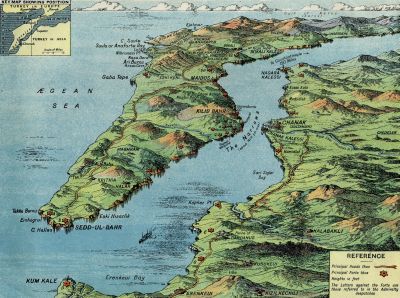
It seems that if you were in the ASC flexibility was necessary as transfers were a regular occurrence. At the end of September 1915, John was transferred to the Local Transport Depot at Imbros and arrived there 5 days later. Imbros now known as Gokceada and the largest island in Turkey, was then under Greek control but in 1915 it was an important staging post for Gallipoli. There was a field hospital, an airfield, administration blocks and stores buildings all constructed for the British Army. Presumably John's job there was to ensure that horses were in good condition and were cared for prior to being shipped the short hop across the water to Gallipoli.

Map courtesy of Mapco
The campaign at Gallipoli had been  continuing since April of 1915. By the end of August it had turned into trench warfare, conditions were worsening from the awful that they already were and dysentery was on the increase. By October the advantage of a continuing campaign had become doubtful but despite this on 6 October John was transported to Carpe Helles and by the 6th November was transferred to the the Corps Transport Depot there. When John arrived in Gallipoli the weather was warm but wet. It was soon to change. During the period 26th to 28th November Gallipoli experienced its worst storm and blizzard for many years. Starting with heavy rain in which the trenches were flooded, so badly flooded that water came up to men's shoulders and many drowned, there then followed snow and then a long frost. 10% of the men on Gallipoli lost their lives to the cold through frostbite and exposure. 280 actually froze to death. The only good thing to come out of this tragedy was that the dysentery stopped and finally a decision was made to evacuate forces from Gallipoli.

Carpe Helles was the last place to be evacuated and John left for Mudros on 6th January 1916, a morning described by Major John Gillam as lovely and calm. I was happy to see the date that John left because the following day they started shooting all the horses and donkeys on Gallipoli in order that they did not fall into the hands of the Turkish Army. I think it would have broken John's heart to shoot the horses he cared for. By 4am on 9th January 1916 Gallipoli had been abandoned and all were gone.

Mudros was and still is a small port on the Greek Island of Lemnos and John joined the Local Transport Depot there awaiting shipping to become available before departing to return to Alexandria and the Base Horse Transport Depot where he arrived on 14 January 1916. There he stayed shoeing and looking after his horses  and continuing his association with the 42nd (East Lancashire) Division, begun at Carpe Helles, for the next 13 months.

On 23 February 1917 John embarked the SS Transylvania in Alexandria and disembarked a few days later in Marseilles. The SS Transylvania was a steamship launched on 23 May 1914. It was originally ordered as a passenger liner for the Cunard subsidiary Anchor Line and was designed to accommodate 1379 passengers however, she was taken over as a troop ship on completion. The Admiralty fixed capacity at 200 Officers plus 2860 men and crew. It would not have been a comfortable cruise! On 3rd May 1917 just two months after John had undertaken his journey to Marseilles, the ship departed that port to return to Alexandria. The following morning at 10am she was torpedoed by a German U boat and sank. 412 men lost their lives.

Picture courtesy of  Wikipedia of SS Transylvania
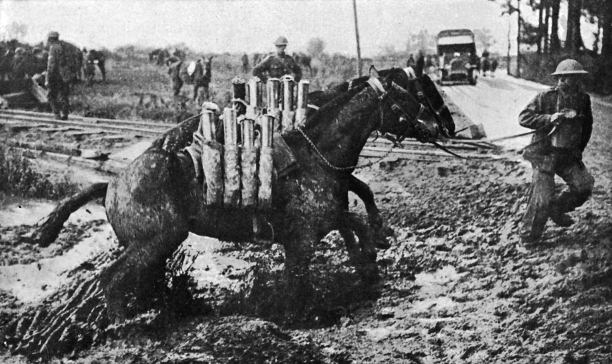
Once in Marseilles John was formerly attached to the 1st East Lancs Field Ambulance 42nd Division and then travelled north to the Western Front with them. The Field Ambulance was a mobile frontline medical unit (not a vehicle) and ASC Drivers like John were attached to the divisions who relied heavily upon horses for transport. Each division had 14 riding plus 52 draught and pack horses who worked 23 wagons, 2 water carts,  forage carts, 6 general service wagons, a cooks wagon and 10 ambulance wagons. John would have been kept busy as he travelled first to the front line at Epehy and then Havrincourt where he stayed, witnessing what I do not wish to imagine until July 1917. John then suffered a 'fever' and following his recovery was finally granted 14 days leave after over two years of service, all undertaken abroad.

On his return from leave John joined the Horse Transport section at 15 Reserve Park, GHQ Troops in France. These units were responsible for heavy artillery (siege) ammunition columns and were expected to hold and maintain sufficient supplies for an infantry division for 2 days. There were 59 general service wagons and 358 horses so once again, John was kept busy. He stayed with this section until the end of the war and was even granted another 11 days leave in March 1918.
Image courtesy of HistoryToday

Armistice Day arrived and John remained in Northern France for a little longer until he succumbed to the Spanish Influenza that by then was claiming so many victims. He was first invalided to Guildford Castle Infirmary on 13 November and then admitted to the Casualty Clearing Station at Eastleigh suffering influenza on 14 November 1918, leaving on 25 November when he was granted 14 days furlough to be residing with his wife and son at Yew Tree Cottage on Foley Road. John was finally discharged to Class Z Army Reserve on demobilization at Woolwich Dockyard on 11 February 1919. He claimed no disability and had an exemplary conduct record.

John also left the army with his Post Office Savings Bank account of which 20 pounds had been deposited during his service. John was a diligent saver and before the balance was transferred to another book in 1925 he had managed to accumulate 58/16s/3d. Perhaps he held dreams of working for himself. Whatever dreams John had at the end of the Great War, they were to be cruelly dashed.

On his return home John, Mary and Jack moved first to Rose Cottage in Stonnall and then in the early 1920s, to a cottage on the Walsall Road in Aldridge. The cottage is still there, behind a hedge by the old mile post just by the junction with Paddock Lane. In its original condition it would have been tiny. His neighbours were the Plants. John got a job as a shoeing smith at one of the Aldridge Collieries, I've never been able to ascertain which one and life continued. John clearly wanted something different to the hard life of labour that he had endured, for his son Jack and Jack trained and became  a weight and scales tester. For a while life was quiet but then in February 1925 John's mother died and it was not so long afterwards that Jack became ill. John and Mary's only child died of a brain tumour on 3rd November 1928 at that tiny cottage on the Walsall Road surrounded by his loving and bereft parents. His gravestone (no longer extant) was inscribed in a simple manner:

"Sacred to the memory of Jack, the beloved son of John Thomas and Mary Ann Mason who passed away November 3rd 1928, aged 22 years. We cannot Lord thy purpose see, but all is well that's done by thee"

Just 12 months later John was standing at that same grave once again, this time burying his wife.

Next door to John my Grandmother Lily, had returned home. She was a tiny, pretty, blonde young woman who had known her own troubles in her short life. She was 20 years younger than John. I like to think that she brought him some happiness and comfort in the dark times that John was enduring. Clearly there was a spark between them but life was a little complicated for them in that Lily was awaiting a divorce. This was finalised in January 1931 and a few weeks later they married. Later that year their daughter was born and a year later my father was born in that same tiny cottage.

And that would have been it for a while had fate not decided to turn her dark hand one last time for John. All his life John had been a survivor. He had survived the extreme poverty and bad luck of his childhood, losing his Father at just three years of age. He survived fighting as a militiaman in the Boer War, not even sustaining injury. He survived Typhoid Fever. He survived Gallipoli. He survived the German U Boats. He survived the Western Front. He survived the Spanish Flu pandemic. He survived the heartbreak of losing his son and wife within 12 months of one another. Unfortunately for John when he contracted bronchitis in September 1937, his poor body that had laboured hard and long all of its life, weakened by Typhoid and Spanish Flu and all the other privations endured, survival was no longer an option. He was just 54 years old. I celebrate my own 54th birthday this year. That brings it all home to me.

There is so much still to be discovered about John but for now, this is his memorial. Another ordinary man, who lived through extraordinary times, who saw places that hadn't even existed in books for him as he was too poor to own them, who witnessed unspeakable horror and who died a long time before I was born but is after all my Granddad.

2 November 2018

A Special Morning for Poppy Road (Station Road) 2 November 2018

 This morning the organisers of the Poppy Road Project, that is Aldridge Great War Project and Aldridge Local History Society put on a lovely walk down Station Road. The first to walk were the organisers along with re-enactors from Cannock Chase, David Dunham the sniper, Ron Mathison the soldier and Evelyn Slater the nurse. They drew quite a crowd. Later in the morning they were joined by West Midlands Mayor Andy Street, Wendy Morton MP and the Aldridge local Councillors.

I got down there early to photograph some of the houses and buildings that have been decorated in the last few days and also to chat with local residents and people who were also walking Poppy Road.

It was a lovely atmosphere and there was much interest. The local air cadets had turned out in force and looked very smart. Other organisations were represented and I apologise for not naming everyone but I didn't get the opportunity to gather all the names but thank you from the people of Aldridge for making the morning such a very special affair.

Following the walk we all enjoyed a warm drink and a cake in The Red Lion were Gail and Bill have made a wonderful effort with the decoration as you will see from the photographs below.

One of the things that has particularly made me think in these last few days has been the silhouettes, the wooden ones representing a young man who died in the Great War and the ones in windows of those who survived. As you walk and see those people represented and honoured now, you see what an enormous impact WW1 had on what was such a small village back then. So many houses missing at least one young man and some houses missing more, for the duration and this is just one road. You realise then the massive sacrifices that everyone in Aldridge made and how village life was affected with their vibrant and lively, young men missing.

Of course many others had their lives affected too, those who now needed to work the land more intensively, those who went to work in munitions factories and there were many in the area and those who now lived in homes missing vital energy and life.

The current residents of Station Road have made this a wonderful tribute to everyone who was there for WW1, serving and non-serving and the efforts of the hundreds of people who knitted, crocheted and crafted are applauded. Thank you.

I thank the organisers of Poppy Road for bringing to life the reality of the life of the village for those who lived 100 years ago. How relieved all those people must have been when the Armistice was signed at the 11th hour of the 11th day of the 11th month of 1918.


Permission was granted by everyone who is photographed here. You may use my photographs but please mention the blog or my name when doing so. For any commercial enterprises a donation to a charity of your choice would be appreciated. Thank you.